 Recently, while working on some website updates, I realized that the language on our contact form doesn’t line up with how we talk about real costs with our homeowners.
Budget
Not that budgets are not of critical importance. Construction costs are up. Labor costs are up. Construction is substantively expensive, and I have yet to meet a client who wasn’t keenly aware of those costs. So we replaced it with this word.
Investment
Investments have limits too, don’t misunderstand. Investment allocations are standard terminology in my morning “Squawk Box” listening. But the word investment carries something that budget doesn’t.
Return
If we are talking about making an investment in your home, you expect a return. And we can frame that return in different ways.
The Financial Return
There’s the financial return – how has your renovation or addition or new construction increased the real value of the property. That one is notoriously difficult to predict long term. Real estate markets are fickle, and we are generally working with clients who are looking at staying in their homes for many business cycles before they think about selling.
The Return You Can’t Pencil Out
We think just as carefully about a less quantifiable but perhaps easier to imagine kind of return. The kind of return that increases your ease in your home, gives you space to grow and live, rooms to celebrate in, to grow families in, to host celebrations in. The kind of return that allows you to live longer in your home a little more safely, taking away some of the anxiety that comes from living in a house that is one fall from requiring a move. That’s real return too. And it’s much less easy to attach to a dollar amount. Instead, it’s measured in years of family dinners, holiday celebrations, grandchildren spending the night, and evenings with friends on the porch.
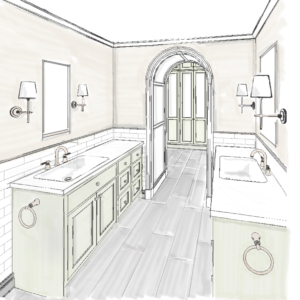
We want our homeowners to have clear pictures of how much their projects will cost, and we want to try and get at those numbers early in the design process. (Our Project Definition service is one way to start that conversation.) Budgets are important. That hasn’t changed. But the reframe is important. Think about it this way. Two bathrooms – same cost: one is an Instagram worthy showpiece and the second is a beautiful bathroom where attention has been paid to accessibility, ease of use, good lighting and materials that will last the long haul. Which one is the better return on the investment?
Thinking about investing in your home?
About Taylor Plosser Davis, AIA
Taylor Plosser Davis, AIA, is the founder of TPD Architecture + Design — a Forbes-recognized residential architecture firm specializing in aging-in-place and luxury senior living design. She holds CAPS certification (Certified Aging-in-Place Specialist) and serves as the 2026 President of AIA Birmingham. With nearly two decades of residential practice, Taylor works at the intersection of beautiful design and long-term livability — what she calls invisible accessibility. She consults with design professionals on aging-in-place strategy and speaks on the future of residential design for an aging population.